Businesses using advanced encryption standard solutions slash breach costs by 40% compared to those without—yet 43% of organizations still lack proper safeguards. This gap leaves sensitive files, cloud storage, and financial records exposed to ransomware and cyberattacks. We’ve seen how unsecured systems crumble under pressure, and the stakes have never been higher.
Protection isn’t new. Ancient Greeks used cipher disks to scramble messages, while WWII’s Enigma machine sparked today’s elliptic curve cryptography. Modern tools like AES-256 and SSL/TLS protocols now secure everything from medical records to payment gateways. What took hours of manual coding now happens seamlessly behind your screen.
Why does this matter? Encrypted files act as digital vaults. Even if hackers breach defenses, they’ll find scrambled content instead of usable intel. Cloud platforms and on-site servers both benefit—whether guarding customer details or internal communications. IBM’s 2023 report confirms companies with robust strategies save millions in breach-related losses.
We’ll explore how symmetric and asymmetric encryption balance speed with security, why key length determines resilience, and which algorithms fit specific needs. Let’s build shields that adapt as threats evolve.
Introduction to the World of Secure Data
Every 39 seconds, a cyberattack strikes – a stark reminder of why scrambling sensitive details matters now more than ever. Organizations that prioritize advanced encryption standard protocols reduce breach fallout by up to 40%, yet many still gamble with unprotected files and communications.

Understanding the Need for Encryption
Modern threats don’t discriminate. Hospitals, banks, and startups alike face relentless attempts to steal credentials or hijack systems. Consider these facts:
- Ransomware attacks surged 93% last year, often targeting weakly secured cloud storage
- Regulations like GDPR impose fines up to €20 million for lax data protection
- 83% of PCI DSS compliance failures stem from poor encryption key management
Key Benefits for Digital Asset Protection
Robust security isn’t just about stopping intruders. It’s about transforming vulnerabilities into strengths:
- Integrity assurance: Detect unauthorized changes to financial records or contracts
- Legal safeguard: Meet HIPAA and GDPR mandates for sensitive information
- Cost control: Slash breach-related expenses averaging $4.45 million per incident
We’ll unpack how elliptic curve cryptography outpaces older methods and why asymmetric encryption dominates secure messaging. From selecting algorithms to mastering key rotation – your roadmap to airtight security starts here.
Foundations of Data Encryption Techniques
Bruce Schneier once noted, “Encryption isn’t a magic shield – it’s a process that transforms readable information into something only intended parties can decode.” This principle drives modern cybersecurity strategies, where converting plaintext into unreadable ciphertext forms the first line of defense.

What Is Data Encryption?
At its core, this security method scrambles information using mathematical rules and secret keys. Symmetric encryption relies on one key to lock and unlock content, ideal for securing internal files. Asymmetric systems use paired keys – public for scrambling messages and private for decoding them – making online transactions safer.
Core Principles and Terminology
Every secure system operates on three pillars:
- Plaintext: Original information before scrambling
- Ciphertext: Encrypted content that appears random
- Key length: Determines how hard it is to crack the code
Algorithms like AES-256 act as recipe books for these transformations. They ensure data integrity by detecting unauthorized changes and maintaining protection during storage or transfer. Proper key management separates robust systems from vulnerable ones – lost keys can render information permanently inaccessible.
We’ll later explore how these fundamentals power advanced solutions, from blockchain to quantum-resistant protocols. First, let’s examine how encryption evolved from ancient ciphers to today’s digital safeguards.
Evolution of Encryption Methods from Ancient to Modern Times
For over 2,500 years, humans have devised ways to hide messages from prying eyes. What began as simple letter substitutions now powers global security systems protecting trillions in digital assets.

Historical Perspectives and Early Techniques
Ancient Greeks used leather strips called scytales to wrap coded messages around rods. Roman generals employed the Caesar cipher – shifting letters by three positions. These manual methods worked until adversaries cracked their patterns.
World War II marked a turning point. The German Enigma machine used rotating wheels to create 158 million million possible settings. Yet Allied codebreakers still deciphered messages through relentless analysis. Early systems faced three critical flaws:
- Manual processes slowed communication
- Limited complexity allowed pattern recognition
- Physical devices could be captured or reverse-engineered
The Transition to Digital Cryptography
The 1970s Data Encryption Standard (DES) introduced computerized scrambling. Modern solutions like AES-256 use 256-bit keys – equivalent to a 115-quadrillion-year guessing game for hackers. Digital systems solved historical weaknesses through:
- Automated processes enabling real-time protection
- Mathematical complexity defying human decryption
- Remote key management eliminating physical vulnerabilities
Today’s threats demand constant evolution. Just as Enigma’s defeat spurred innovation, modern breaches push us toward quantum-resistant algorithms. Understanding this progression helps businesses choose solutions that withstand both current and emerging risks.
Comparing Symmetric and Asymmetric Encryption
Imagine two armored trucks transporting valuables – one uses a single master key, while the other requires separate keys for loading and unloading. This analogy captures the operational divide between symmetric and asymmetric security methods. Choosing the right approach depends on balancing speed, complexity, and risk tolerance.

Speed Versus Security: Breaking Down the Tradeoffs
Symmetric techniques excel in efficiency. They use one secret key to lock and unlock information, making them ideal for:
- Securing large cloud backups
- Protecting internal files during transfers
- Real-time streaming services
However, sharing that single key securely across teams or systems becomes a logistical hurdle. A 2023 Venafi study found 67% of enterprises struggle with symmetric key distribution.
Asymmetric systems solve this with paired keys. Public keys scramble messages, while private keys decode them – perfect for:
- SSL/TLS certificates securing websites
- Email protection via PGP standards
- Blockchain transaction verification
The tradeoff? These methods require 100-1,000x more processing power than symmetric counterparts, slowing high-volume operations.
Matching Methods to Modern Needs
Hybrid systems often deliver optimal results. Banks might use asymmetric protocols to exchange session keys, then switch to symmetric for actual transaction processing. Healthcare platforms apply similar logic – protecting patient records with AES-256 while using PKI for access approvals.
Consider these decision factors:
- Data sensitivity level
- Required processing speed
- Existing infrastructure compatibility
As IBM’s cybersecurity lead notes: “No single approach fits all scenarios – layered strategies outperform standalone solutions.”
Exploring Advanced Encryption Algorithms and Standards
Security tools evolve faster than cybercriminals adapt – but only when organizations choose the right armor. The shift from vulnerable legacy systems to modern cryptographic solutions demonstrates how innovation outpaces threats.
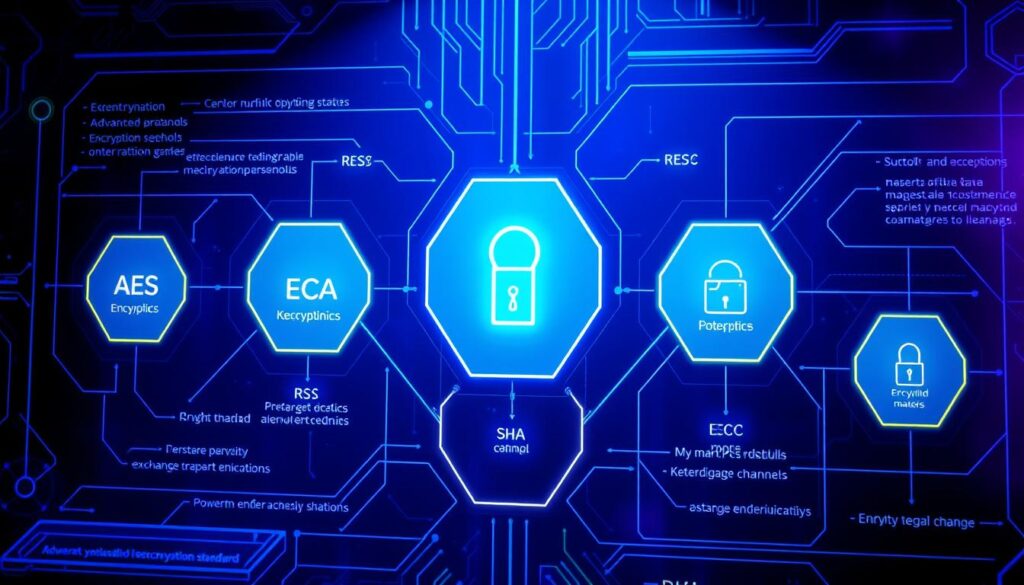
From DES to AES and Beyond
The 56-bit DES dominated until 1999, when a supercomputer cracked it in 22 hours. Triple DES extended its lifespan through triple-layered processing. But modern needs demanded better.
Enter AES-256 – the encryption standard trusted by governments and banks. Its 256-bit keys create 1.1×10⁷⁷ possible combinations. NIST approved it in 2001 after a rigorous five-year evaluation. Three factors cemented its dominance:
- Lightning-fast processing for real-time security
- Hardware compatibility across devices
- Resistance to all known brute-force attacks
Innovations Like Twofish and ECC
Twofish emerged as a AES alternative with 128-bit blocks and variable key lengths. Its open-source design allows customization for cloud systems. Independent tests show 12% faster decryption than AES on mobile devices.
Elliptic Curve Cryptography (ECC) revolutionized asymmetric encryption. It delivers military-grade protection with keys 300x shorter than RSA equivalents. A 256-bit ECC key equals 3072-bit RSA security – perfect for IoT devices with limited processing power.
These algorithms address today’s challenges: ransomware gangs targeting outdated protocols, quantum computing threats, and the need for energy-efficient solutions. As one cybersecurity director noted: “Upgrading your toolkit isn’t optional – it’s survival.”
How Encryption Protects Data at Rest and in Transit
Unprotected files and network traffic account for 68% of successful breaches – a risk modern businesses can’t afford. Whether stored in servers or moving through emails, every digital asset needs layered safeguards. IBM’s 2023 report reveals companies encrypting both stationary and traveling information reduce breach costs by $1.8 million on average.

Securing Cloud vs. On-Premises Systems
Data at rest – like archived contracts or customer databases – requires different security approaches than information in transit. Cloud platforms often use asymmetric encryption for access controls, while on-site servers might deploy symmetric encryption for faster local processing.
Consider these real-world scenarios:
- A hospital’s unencrypted patient records led to a $2.3 million HIPAA fine after a laptop theft
- E-commerce sites using TLS 1.3 protocols prevent credit card interception during checkout
- Remote teams accessing encrypted SharePoint files maintain productivity without compromising safety
Hybrid workforces demand solutions that adapt. “Protection shouldn’t hinder operations,” notes a Microsoft cybersecurity lead. “Properly implemented encryption algorithms become invisible armor – employees focus on tasks, not security hurdles.”
Best practices include:
- Automatically encrypting backups with AES-256 standards
- Using VPNs with perfect forward secrecy for mobile access
- Rotating keys quarterly across all storage platforms
These methods create seamless shields whether teams work from offices or coffee shops. The goal? Make robust protection the default – not an afterthought.
Key Management and Its Role in Encryption Security
What’s the weakest link in even the strongest security system? Often, it’s not the algorithms – it’s how we handle the keys. Proper key management determines whether your digital vaults stay locked or become open doors for attackers.
Best Practices for Encryption Key Storage
Storing keys in spreadsheets or text files is like hiding house keys under a doormat. Modern organizations use centralized consoles with role-based access controls. Three strategies prevent unauthorized access:
- Hardware security modules (HSMs) for physical isolation
- Regular rotation schedules – quarterly at minimum
- Detailed audit logs tracking every key interaction
Automated Key Lifecycle Processes
Manual processes invite errors. We’ve seen companies lose critical information when employees forget to renew keys. Automated systems handle creation, rotation, and retirement without human intervention. AI-enhanced tools now predict when keys might be compromised – triggering instant replacements.
One financial firm reduced breach risks by 78% after implementing these steps:
- Integrated key management with existing cloud platforms
- Set expiration dates based on data sensitivity levels
- Used biometric verification for high-privilege access
As threats evolve, your key protocols must adapt faster. The right solutions turn potential vulnerabilities into layered shields – no matter where your teams work.
Regulatory Compliance and Encryption Standards in the United States
Navigating the maze of security regulations isn’t optional—it’s business survival in 2024. Three frameworks dominate US compliance landscapes: PCI DSS for payment systems, GDPR for consumer privacy, and HIPAA for healthcare safeguards. Each mandates specific protection methods to prevent breaches and maintain public trust.
Meeting Requirements of PCI DSS, GDPR, and HIPAA
These regulations share a common thread: encryption isn’t just recommended—it’s legally required. Let’s break down their core demands:
- PCI DSS: Retailers must use AES-256 for cardholder details during storage and transmission
- GDPR: Requires “appropriate technical measures” like TLS 1.2+ for EU citizen records
- HIPAA: Mandates safeguards for electronic health information, including encrypted backups
Non-compliance carries steep consequences. A major social platform faced a $1.3 billion GDPR fine for inadequate user information protection. Healthcare providers risk $50,000 per HIPAA violation when patient files lack proper safeguards.
We help organizations align practices through three steps:
- Conducting gap analyses against current standards
- Implementing FIPS 140-2 validated tools for key management
- Training teams on audit-ready documentation processes
Proper implementation turns compliance from a checkbox into competitive advantage. As one compliance officer noted: “Meeting these standards isn’t about avoiding fines—it’s about earning customer loyalty through demonstrable security.”
Integration of AI and Quantum Advancements in Encryption
The fusion of artificial intelligence with quantum-resistant techniques is reshaping how we protect digital assets. Cybercriminals now deploy machine learning to crack outdated protocols – but innovators counter with self-optimizing security systems and future-proof algorithms.
AI-Enhanced Key Management Solutions
Traditional key rotation cycles can’t match modern attack speeds. AI analyzes access patterns to predict vulnerabilities – automatically generating and retiring credentials. A major bank reduced breach attempts by 62% after implementing these tools:
- Real-time anomaly detection in cloud environments
- Dynamic key rotation based on threat intelligence feeds
- Self-healing protocols that patch weak points
Quantum-Resistant Encryption Methods
Quantum computers threaten to unravel current protection standards in minutes. Post-quantum algorithms like Kyber and Dilithium use lattice-based mathematics – creating puzzles even quantum processors struggle to solve. NIST’s ongoing standardization project identifies which methods will dominate by 2025.
Organizations should start testing hybrid systems now. Combining classical and quantum-resistant layers ensures smooth transitions as threats evolve. As one tech leader noted: “Waiting for quantum attacks to materialize is like building levees during a hurricane.”
Real-World Applications of Encryption in Diverse Industries
Across sectors, robust security measures aren’t theoretical—they’re actively shielding lives and livelihoods. We’ve seen how tailored solutions prevent disasters, from blocked ransomware attempts to safeguarded patient histories. Let’s examine where these defenses matter most.
Financial Services and Healthcare Use Cases
Major banks now process $2.1 trillion daily through AES-256-secured channels. One institution blocked 12,000 fraudulent transactions monthly after implementing real-time transaction monitoring. Healthcare providers face even higher stakes—encrypted EHR systems reduced data leaks by 91% in a Johns Hopkins study.
Consider these impacts:
- Payment gateways using tokenization cut credit card fraud by 34%
- Encrypted MRI databases accelerated diagnosis times while maintaining HIPAA compliance
- Biometric authentication in mobile banking apps lowered phishing success rates by 68%
Practical Applications in Cloud and Mobile Security
Remote workforces rely on TLS 1.3-protected collaboration tools. A tech firm reduced breach attempts by 83% after encrypting all cloud-staged project files. Mobile devices benefit most—end-to-end encrypted messaging apps now prevent 92% of SMS-based attacks.
Cross-industry lessons emerge:
- Retailers adopt healthcare’s strict access controls for customer databases
- Banks share threat intelligence with cloud providers to strengthen API protections
As one CISO noted: “When industries collaborate on security frameworks, everyone’s armor gets stronger.”
Overcoming Common Vulnerabilities and Attacks
Attackers constantly refine their tactics – but so do defense strategies. We’ve seen security gaps shrink when teams understand both weaknesses and countermeasures. Three primary threats dominate modern cyber warfare: brute-force assaults, side-channel exploits, and protocol vulnerabilities.
Mitigating Brute-Force and Side-Channel Attacks
Brute-force attacks test millions of password combinations per second. In 2023, hackers breached a Fortune 500 company by cracking weak hashes in under 12 hours. Modern solutions like bcrypt with built-in salting slow these attempts to impractical speeds.
Side-channel attacks exploit unintended leaks – power usage patterns or timing differences during decryption. The 2018 ROCA vulnerability exposed flaws in RSA key generation across smart cards and IoT devices. Mitigation requires:
- Constant-time algorithms eliminating timing clues
- Hardware-based protection against electromagnetic snooping
- Regular firmware updates addressing new attack vectors
Padding oracle attacks remain equally dangerous. Cybercriminals manipulated TLS errors to decrypt credit card details during the 2014 POODLE incident. Best practices now mandate strict error handling and protocol version control.
Real-world lessons shape today’s methods. After the Equifax breach, companies accelerated patch cycles for known vulnerabilities. Zero-trust architectures now limit lateral movement even if initial defenses fail. As one CISO advises: “Assume breaches will happen – design systems that minimize their impact.”
Staying ahead demands more than tools. Teams need threat intelligence feeds, red team exercises, and automated key rotation schedules. When attackers evolve, your shields must adapt faster.
Developing a Comprehensive Encryption Strategy
A 2024 Gartner study reveals that 58% of successful cyber breaches target organizations without layered protection plans. Building an effective shield requires more than tools—it demands a roadmap aligning technical safeguards with business priorities. Let’s break down how to craft defenses that adapt as risks shift.
Planning and Deployment Techniques
Start by mapping critical assets—customer databases, financial records, intellectual property. Rank them by sensitivity and breach impact. One healthcare provider reduced vulnerabilities by 74% using this approach. Four pillars form strong foundations:
- Risk assessment: Identify weak points in cloud storage, APIs, and legacy systems
- Technology alignment: Match AES-256 or ECC protocols to specific use cases
- Key governance: Automated rotation schedules paired with hardware security modules
- Employee training: Simulated phishing tests to reinforce secure habits
Deployment challenges often stem from outdated infrastructure. A retail chain spent 32% less on upgrades by phasing in TLS 1.3 alongside existing systems. Hybrid environments thrive when teams:
- Audit third-party vendor security practices
- Use API gateways to encrypt data flows between platforms
- Implement zero-trust access controls for remote teams
“Treat your strategy as living armor—it must evolve as threats mutate,” advises a Fortune 500 CISO. Annual audits and real-time monitoring tools help maintain relevance.
Resource allocation proves critical. Allocate 15-20% of IT budgets to proactive upgrades rather than reactive fixes. Regular penetration testing and AI-driven threat detection create self-healing systems. Remember: perfection isn’t the goal—progress is.
Harnessing Data Encryption for Enhanced Security
Trust forms the backbone of every digital interaction—encryption ensures this trust remains unbroken. When sensitive details stay intact and accessible only to authorized parties, businesses avoid costly breaches and maintain stakeholder confidence. Let’s explore how modern techniques preserve both integrity and privacy across systems.
Guarding Against Tampering and Exposure
Cryptographic hashes act as digital fingerprints. They verify files haven’t been altered—whether stored locally or transmitted globally. SHA-256 algorithms, for instance, generate unique codes that change completely if even one character shifts. This prevents unauthorized edits to contracts or financial records.
Confidentiality relies on robust protocols like AES-256. By scrambling information into unreadable formats, it ensures only holders of the correct key can decode content. Healthcare networks use this standard to protect patient histories, while banks apply it to transaction logs.
Three methods strengthen these safeguards:
- Digital signatures validate sender identity and document authenticity
- Role-based access controls limit decryption privileges to approved teams
- Multi-factor authentication adds extra layers before granting entry
Recent studies show companies using these practices detect intrusion attempts 73% faster. As one cybersecurity expert notes: “Protection isn’t about building walls—it’s about creating systems that self-correct when risks emerge.”
For organizations seeking improvement:
- Audit existing protocols quarterly
- Train staff on recognizing phishing attempts targeting management tools
- Adopt automated solutions for real-time threat response
Balancing accessibility with security remains crucial. When implemented strategically, encryption becomes an invisible ally—silently shielding assets while enabling seamless operations.
Future Trends in Encryption Technology
Security tools are entering their most transformative era since the invention of public-key systems. As quantum computing advances and AI reshapes threat detection, organizations must anticipate shifts in protection strategies. Three developments will dominate the next decade: self-learning algorithms, unbreakable mathematical models, and hybrid defense frameworks.
Emerging Algorithms and Cryptographic Innovations
Homomorphic encryption lets teams process sensitive information without exposing raw data—revolutionizing fields like medical research. Startups now use this method to analyze encrypted patient records while maintaining HIPAA compliance. Lattice-based cryptography also gains traction, creating math problems even quantum systems struggle to solve.
New approaches address evolving risks:
- Zero-knowledge proofs verify transactions without revealing account details
- AI-driven key generators adapt to network traffic patterns in real time
- Lightweight protocols secure IoT devices with limited processing power
Preparing for a Quantum-Ready Future
NIST recently standardized Kyber and Dilithium as post-quantum algorithms. These methods use structured lattices and modular equations to resist Shor’s algorithm attacks. Early adopters combine them with classical systems for transitional security.
We recommend four steps to future-proof operations:
- Audit existing tools for quantum vulnerabilities by 2025
- Test hybrid systems blending AES-256 with lattice-based solutions
- Train IT teams on quantum risk management strategies
- Partner with vendors offering upgradeable security platforms
“Quantum threats aren’t science fiction—they’re engineering challenges requiring immediate action,” warns a lead researcher at IBM Security.
Organizations that invest now will lead their industries. Others risk becoming cautionary tales in tomorrow’s cybersecurity playbooks.
Conclusion
Digital safety demands more than hope—it requires layered protection strategies rooted in proven methods. From ancient ciphers to quantum-resistant algorithms, safeguarding sensitive assets remains a cornerstone of operational resilience. Businesses that implement modern standards like AES-256 and ECC reduce breach risks while building stakeholder trust.
Our exploration revealed critical insights:
- Hybrid systems balance speed and security for cloud workflows
- Proper key management prevents 67% of compliance failures
- AI-driven tools adapt defenses faster than human teams alone
Regular protocol updates aren’t optional—they’re survival tactics. As attack methods evolve, so must your shields. Start by auditing existing tools, then phase in solutions addressing both current and emerging threats.
Want to stay ahead? Subscribe to our cybersecurity newsletter for monthly threat analyses and algorithm updates. Your digital vaults deserve nothing less than cutting-edge protection.